Nuclear energy progress in 2024
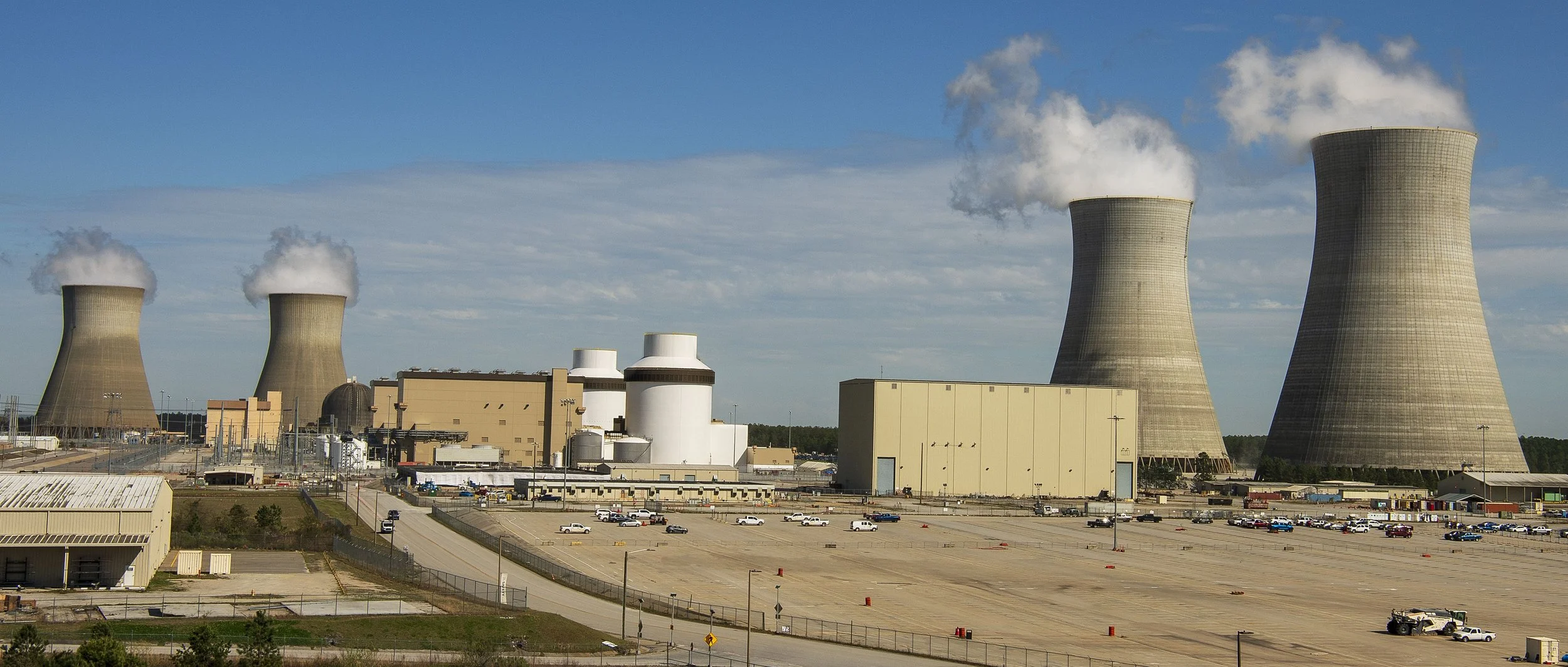
Plant Vogtle at Waynesboro, Georgia
Excerpts and summaries of
11 Big Wins for Nuclear in Trump Administration's First 100 Days
U. S Department of Energy
April 29, 2025
1. Plant Vogtle unit 4 enters commercial operation
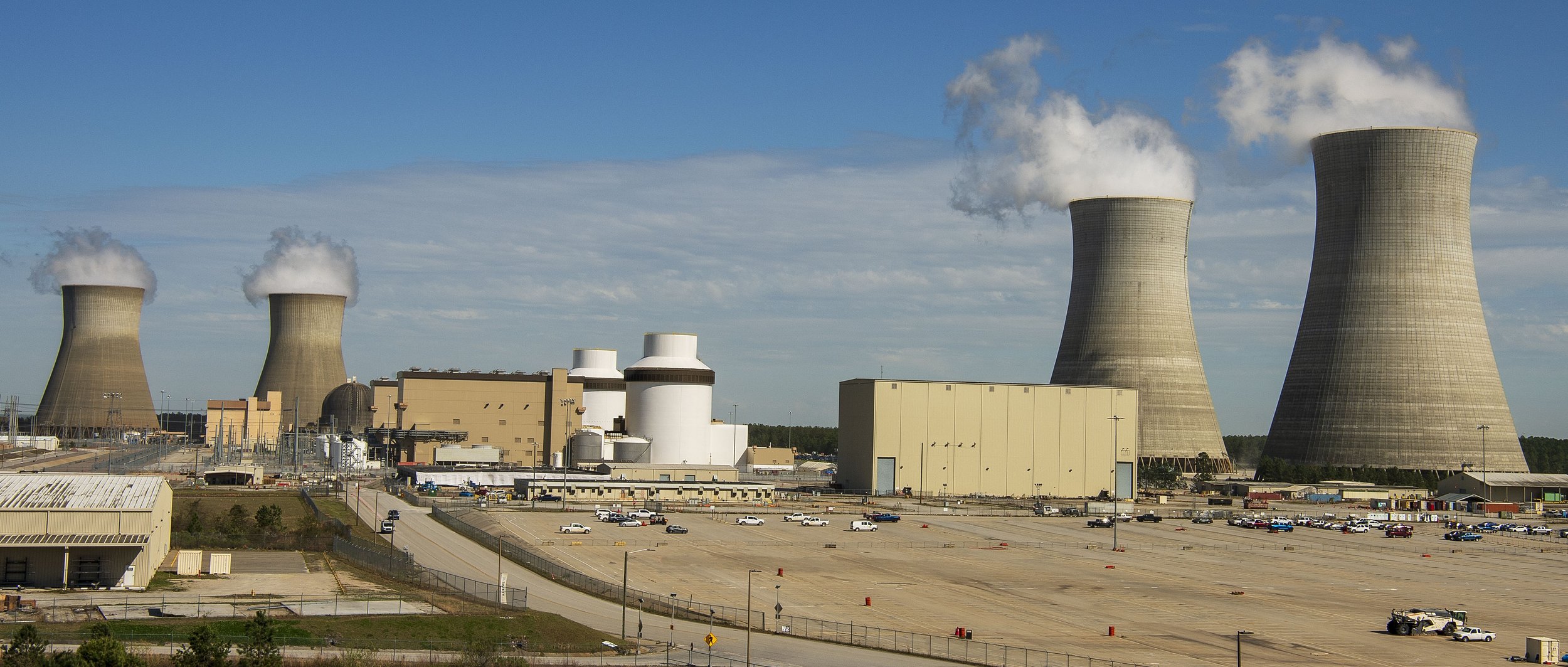
Vogtle nuclear powerplant
Georgia Power photo
. . .
Vogtle 4 entered commercial service on April 29 to wrap up the power plant’s expansion project in Waynesboro, Georgia.
Plant Vogtle is now the largest clean power generator in the country and is home to two AP1000 reactors, which are the first new builds in the United States in more than 30 years.
The expansion project received approximately $12 billion in loan guarantees from the U.S. Department of Energy (DOE) and played a crucial role in helping to retrain the workforce — supporting 9,000 jobs at peak construction.
DOE recently started a new reactor safety and workforce development program to support expected job growth in the sector and the long-term maintenance of U.S. reactors, which now stands at 94.
2. Palisade reactor re-start planned
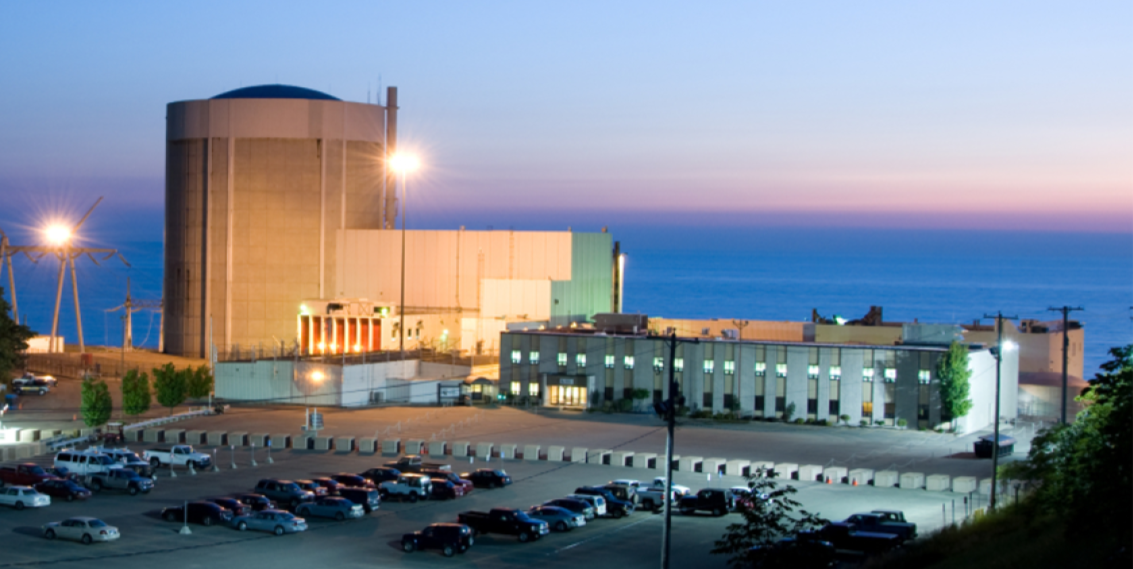
Palisade Nuclear Power Plant
US Department of Energy photo
. . .
DOE closed a $1.52 billion loan to repower and upgrade the Palisades nuclear power plant in Michigan. The single-unit 800-megawatt reactor shut down in May 2022 and would be the first reactor ever recommissioned in the United States, if approved by the U.S. Nuclear Regulatory Commission (NRC).
The project is expected to support or retain up to 600 high-quality jobs and is the first loan closed through DOE’s Energy Infrastructure Reinvestment program created under the Inflation Reduction Act.
Holtec plans to bring the plant back online in 2025.
Constellation also announced its plans to restart Three Mile Island Unit 1 in Pennsylvania thanks to a 20-year power purchase agreement with Microsoft to power its data centers.
The plant will be renamed the Crane Clean Energy Center and is expected to be online in 2028, pending regulatory approval.
3. U.S. Deployment Targets
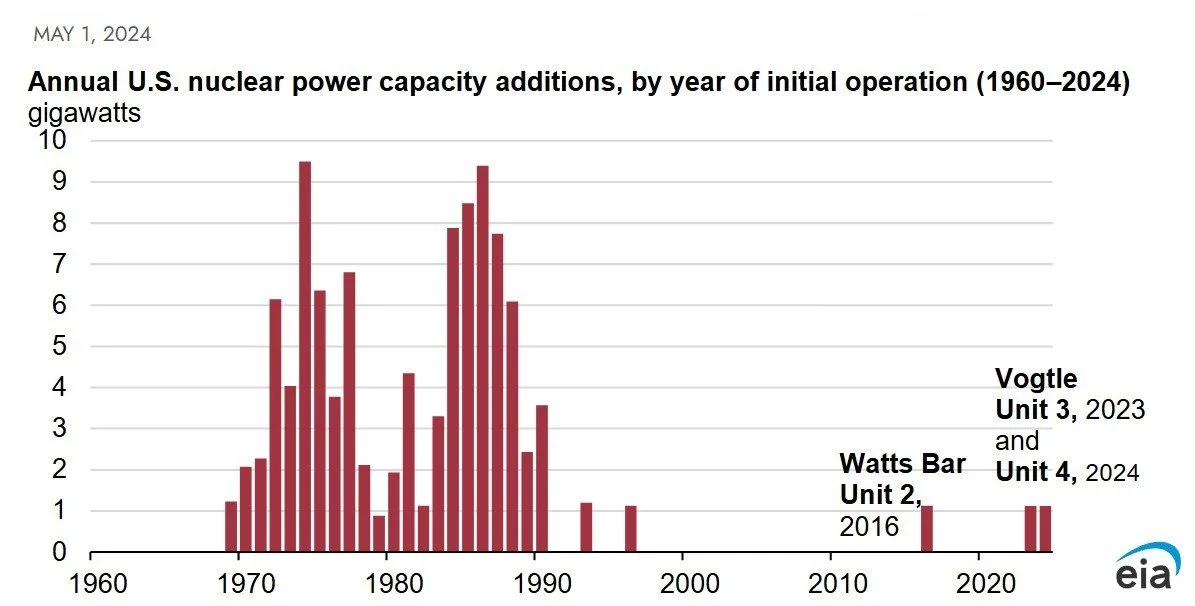
Annual US nuclear power capacity additions, 1960-2024
U.S. Energy Information Administration chart
. . .
Last year, the United States joined more than 20 countries in pledging to triple global nuclear energy capacity by 2050, and now we have a plan to get there.
The White House released nuclear deployment targets this year to expand domestic capacity by 200 gigawatts (GW).
The plan outlines more than 30 actions the U.S. government can take to add 35 GW of new capacity by 2035 and achieve a sustained pace of 15 GW per year by 2040.
Most of that capacity could come from existing power plant sites.
Preliminary research shows that a majority of our nuclear power plants could host up 95 GW of new capacity. An additional 174 GW could also be built near U.S. coal plants, depending on the reactor type.
DOE also released a new information guidebook to support energy communities exploring these coal-to-nuclear transitions.
4. Securing a domestic nuclear fuel cycle
DOE is working to grow our domestic nuclear fuel supply chain by selecting multiple companies to participate in low-enriched uranium and high-assay low-enriched uranium capacity building programs. The $3.4 billion effort will allow the awardees to bid on future task orders to produce, store, and deconvert material that can be fabricated into fuel for current and future reactors.
The funding underpins the nation’s contributions to a multilateral commitment made at COP28 between the United States, Canada, France, Japan, and the United Kingdom to mobilize $4.2 billion in government-led investments to establish a global uranium supply market that is free from Russian influence.
The United States also took crucial steps toward strengthening our domestic energy security by issuing a ban on imported uranium products from Russia.
The move is a key piece to a larger strategy to build new production capacity in the United States and transition away from Russian-sourced fuel, which currently makes up more than 20 percent of our enriched uranium imports for nuclear fuel.
5. Groundbreaking projects
Several DOE-supported projects started construction in 2024, bringing the United States one step closer to the deployment of new advanced small modular and microreactor systems.
Natrium
TerraPower started non-nuclear construction on a sodium test facility in support of its Natrium reactor in Kemmerer, Wyoming.
The 345-MWe sodium-cooled fast reactor and energy storage system is being built near a retiring coal plant to leverage the available infrastructure and workforce in the area.
The NRC accepted the company’s construction permit application in May for review, which is being implemented through a modernized licensing framework methodology to streamline the review process for non-light-water reactor designs.
The demonstration project is being led by DOE’s Office of Clean Energy Demonstrations.
Project Pele
The Department of Defense broke ground on its Project Pele microreactor at Idaho National Laboratory.
DoD is planning to design, build, and demonstrate a transportable high-temperature gas reactor that will operate at the lab’s Critical Infrastructure Test Range Complex. The Pele reactor is being authorized and approved by DOE’s Idaho Operations Office.
The demonstration is being led by DoD’s Strategic Capabilities Office and could be one of the first advanced reactors to operate in the United States as early as 2026.
Hermes
Kairos Power also started construction on its Hermes reactor in Oak Ridge, Tennessee.
The project is one of several projects being supported through DOE’s Advanced Reactor Demonstration Program.
The low-power reactor is being used to inform the development of the company’s commercial fluoride salt-cooled, high-temperature reactor.
The NRC also cleared a second plant, Hermes 2, for construction in late November.
6. Deploying new reactors
DOE launched a $900 million program to demonstrate up to two advanced light-water small modular reactor systems in the United States.
The new program encourages a consortium-based approach to lower the risk of deploying new reactor technologies. It will also facilitate multi-reactor order books and provide additional support to build out the advanced light-water reactor supply chain.
Advanced light-water systems incorporate enhanced safety features and modern instrumentation and controls to improve performance while offering the potential to reduce construction, operations, and maintenance costs.
The two first-mover projects will be managed by DOE’s Office of Clean Energy Demonstrations, while the Office of Nuclear Energy manages the siting, supply chain, and cost estimating initiatives.
7. Consolidated interim storage facility
DOE is moving forward on a project to design, build, and operate a federal consolidated interim storage facility for spent nuclear fuel that would be sited through the Department’s consent-based siting process.
The project cleared the first procedural step for DOE capital asset projects, which determines a mission need for the agency.
The facility would be licensed by the NRC and initially built to store around 15,000 metric tons of spent nuclear fuel, with options to expand.
It would also include the development of new modern railcars like the Atlas railcar, which was cleared for operation this year, to eventually transport the spent nuclear fuel. Atlas railcar design and testing partners included the Federal Railroad Administration Transportation Technology Center (TTC) at Pueblo, Colorado and Oak Ridge National Laboratory.
Construction and operation of the federal consolidated interim storage facility would require amendments to the Nuclear Waste Policy Act of 1982 to allow those phases of the project to move forward.
. . .
more info
8. Spent fuel shipment to Idaho National Lab
After years of negotiating with the state of Idaho, and dozens of deliverables achieved by the U.S. government to manage the state’s legacy waste, Idaho National Laboratory received its first shipment of spent fuel since the 1990s.
The data generated from the 25 fuel rods will be crucial to developing and licensing new fuel technologies designed to enhance safety performance and operate for longer periods of time in a reactor — ultimately saving customers money on their energy bills.